
Views: 0 Author: Site Editor Publish Time: 2026-07-09 Origin: Site


The architectural integrity of a building exterior relies heavily on the chemical composition of its metal panel finish. Specifying the wrong fluoropolymer coating for architectural cladding leads to premature chalking, UV degradation, and costly remediation. Architects and specifiers must balance upfront material requirements against long-term performance, fabrication limits, and aesthetic needs. An objective, data-driven comparison of Fluoroethylene Vinyl Ether (FEVE) and Polyvinylidene Fluoride (PVDF) technologies establishes clear specification criteria for aluminum composite panel projects. We will examine the exact chemical differences, application limits, and performance metrics necessary to make the right specification choice for your next architectural project. You need to understand how these resins behave during factory coil coating, post-fabrication bending, and decades of environmental exposure. This guide provides the technical foundation to evaluate both systems accurately, ensuring your exterior envelope performs exactly as designed under real-world conditions.
Table of Contents
Industry Standard vs. Premium Aesthetics: PVDF is the mature, widely adopted standard for extreme weatherability in matte and satin finishes, while FEVE commands a price premium for high-gloss, ultra-vibrant color retention and field-applicability.
Resin Formulation Differences: PVDF requires a blend with acrylic resins (typically 70/30) which introduces a weak point for UV degradation, whereas FEVE is a 100% fluoropolymer thermoset structure with superior inherent hardness.
Fabrication and Forming: PVDF's thermoplastic nature makes it highly flexible and ideal for post-forming and bending ACPs, whereas FEVE’s thermosetting cross-linking yields a harder surface but less flexibility during post-fabrication bending.
Environmental & Compliance Factors: Both coatings can meet strict AAMA 2605 architectural standards, but powder-coated FEVE offers advantages in material reclamation and zero-VOC emissions compared to traditional liquid PVDF.
Lifecycle ROI: Both resin systems typically offer 20-to-30-year warranties; the choice hinges on specific project demands regarding gloss levels, post-forming fabrication requirements, environmental exposure, and initial budget constraints.

PVDF, or Polyvinylidene Fluoride, is a non-reactive thermoplastic fluoropolymer. It serves as the foundation for modern architectural metal finishes. The industry-standard formulation blends 70% PVDF resin with 30% acrylic resin. The acrylic component remains necessary for pigment dispersion and substrate adhesion. However, this acrylic portion acts as the primary site for UV degradation over time. Specifying PVDF Coating for Aluminum Composite Panels guarantees performance reliability. It holds historical dominance and maturity in the architectural cladding and coil coating market. You can trust its proven track record across decades of global construction projects.
When we look at the application side, PVDF requires a high-temperature bake to fuse the resin particles into a continuous film. This process happens on massive coil coating lines where aluminum unwinds, gets cleaned, treated, painted, and baked in a continuous loop. The resulting finish provides excellent resistance to airborne pollutants, salt spray, and harsh weather. Because it is a thermoplastic, the cured film remains relatively soft and flexible. This flexibility allows fabricators to route, fold, and roll the coated aluminum into complex shapes without cracking the paint.
FEVE stands for Fluoroethylene Vinyl Ether. It operates as a thermosetting fluoropolymer. The alternating copolymer structure defines its performance capabilities. Fluoroethylene segments provide extreme weatherability and UV protection. Vinyl ether segments provide high gloss, solubility, transparency, and cross-linking capabilities. FEVE functions as a 100% fluoropolymer resin system. It completely avoids the vulnerable acrylic blending agents required by PVDF. This technology emerged as a high-performance alternative for specialized architectural applications. It excels when projects demand high gloss levels or require field application.
Unlike PVDF, FEVE cross-links during the curing process. This chemical reaction creates a tight, hard molecular network. You get a surface that resists scratching and abrasion far better than standard thermoplastic coatings. Furthermore, chemists can formulate FEVE to cure at ambient temperatures. This unique trait allows painting contractors to apply high-performance fluoropolymer coatings directly on the job site. If a building facade suffers damage or requires a color change after twenty years, FEVE provides a viable path for field restoration without sacrificing AAMA 2605 performance levels.
PVDF carries inherent aesthetic limitations. It is naturally low-gloss, typically maxing out at 30 to 40 units on a 60-degree gloss meter. It remains limited in achieving ultra-bright, highly saturated, or dark metallic colors. Pushing these limits risks accelerated fading. The acrylic portion simply cannot protect highly vibrant pigments from UV radiation over long periods. If you specify a bright fire-engine red in a standard PVDF system, you will likely see noticeable fading within a few years.
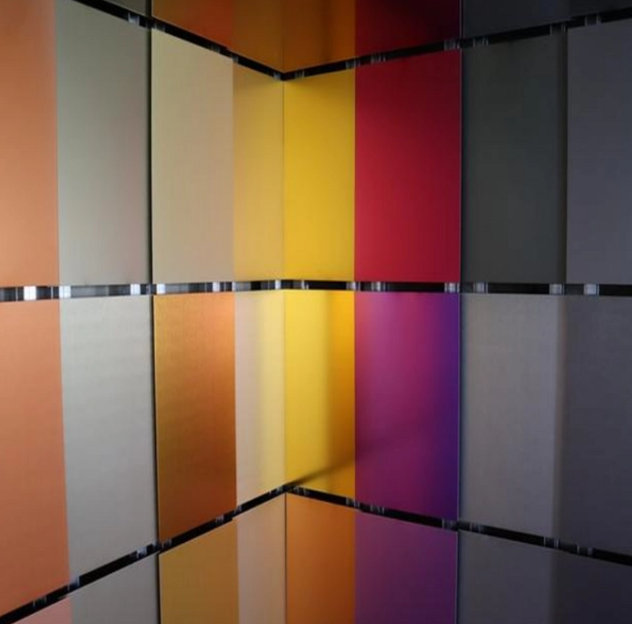
FEVE offers distinct aesthetic advantages. It easily achieves high-gloss finishes ranging from 15 to over 90 units. The thermoset structure supports a significantly wider color gamut. You can specify bright corporate branding colors, high-vibrancy reds, yellows, and deep metallics without sacrificing longevity. The clear nature of the FEVE resin allows the true color of the pigments to shine through without the milky haze sometimes associated with PVDF blends.
Both systems rely on strong molecular bonds. The carbon-fluorine bond strength protects against severe UV radiation. However, their degradation mechanisms differ completely. The acrylic portion of a PVDF coating degrades over time. This leads to chalking, which is resin erosion, and fading due to pigment exposure. As the acrylic breaks down, the pigment particles wash away in the rain. FEVE provides uniform erosion resistance thanks to its cross-linked structure. The entire resin matrix degrades at an incredibly slow, uniform rate.
Both systems successfully benchmark against stringent physical performance requirements. They routinely meet AAMA 2605 standards for high-performance organic coatings on architectural extrusions and panels. This standard requires the coating to endure ten years of South Florida exposure while maintaining specific limits on color fade (maximum 5 Delta E) and chalking (minimum rating of 8). Both resins pass this test, but FEVE typically shows less gloss loss and color shift at the end of the testing period.
The structural difference dictates physical durability. FEVE features a cross-linked molecular structure. This results in a harder cured film, typically measuring 2H to 3H pencil hardness. It offers superior scratch and abrasion resistance. This makes it ideal for high-traffic areas at ground level where pedestrians might brush against the panels or where maintenance crews frequently wash the building.
PVDF relies on thermoplastic flexibility. It typically measures F to H pencil hardness. This flexibility allows for radical post-forming, bending, and roll-forming of panels. You can fold and shape PVDF-coated panels without micro-cracking or crazing along the bends. When fabricating aluminum composite panels, workers route a V-groove into the back of the panel and fold the edge 90 degrees to create a mounting cassette. PVDF handles this 1T or 2T bend radius effortlessly. FEVE, being harder and more brittle, requires larger bend radii or pre-forming the metal before applying the coating to prevent cracking at the fold line.
Performance Metric | PVDF (70/30 Blend) | FEVE (100% Fluoropolymer) |
|---|---|---|
Resin Structure | Thermoplastic | Thermoset (Cross-linked) |
Gloss Range (60° Meter) | Low to Medium (10 - 40 units) | Low to High (15 - 90+ units) |
Pencil Hardness | F to H | 2H to 3H |
Post-Forming Flexibility | Excellent (Handles tight bends) | Limited (Prone to micro-cracking on tight bends) |
Curing Requirements | High-temperature factory bake only | Factory bake or ambient field cure |
Factory coil coating applies both finishes efficiently. Manufacturers apply liquid PVDF and FEVE to continuous aluminum coils. They laminate these coated coils to the composite core afterward. The coil coating process ensures a highly uniform film thickness, typically around 0.2 mils for the primer and 0.8 mils for the color coat. This automated application guarantees consistent color matching across thousands of square feet of material.
Curing profiles differ significantly. PVDF requires high-temperature factory baking, typically between 240°C and 250°C Peak Metal Temperature (PMT). FEVE offers dual curing capabilities. It supports high-temperature factory baking or ambient-temperature cross-linking in the field. This gives FEVE a distinct advantage for on-site touch-ups. You can execute structural repairs or full-scale field restorations of weathered panels easily.
When executing a field restoration using FEVE, contractors follow a strict protocol:
Power wash the existing facade to remove loose dirt, environmental contaminants, and heavy chalking.
Abrade the weathered surface using mechanical sanders or abrasive pads to create a physical profile for adhesion.
Wipe down the entire surface with approved solvents to remove residual dust and oils.
Apply a specialized bonding primer designed to adhere to the old fluoropolymer coating.
Spray or roll the ambient-curing FEVE topcoat, ensuring proper wet film thickness to achieve the desired gloss and color opacity.
Liquid PVDF and liquid FEVE formulations both emit Volatile Organic Compounds during application. Coil coating facilities capture these emissions using massive thermal oxidizers. These oxidizers burn off the VOCs, converting them into heat energy that helps fuel the curing ovens. This closed-loop system minimizes environmental impact during factory production.
The industry continues shifting toward powder coatings to mitigate VOCs entirely. Powder-coated FEVE allows almost complete reclamation of overspray materials. Factory application captures up to 99% of unused powder, minimizing waste. Energy consumption differences also play a role. Ambient-curing FEVE reduces energy loads during field applications. Factory baking for both systems requires substantial energy input to achieve proper film formation.

Selecting between PVDF and FEVE coatings should be based on total lifecycle cost rather than purchase price alone. Material cost, maintenance requirements, service life, and project environment all influence the long-term return on investment.
In most projects, FEVE coatings have a higher initial cost than standard PVDF systems because of the resin formulation and manufacturing process. However, the actual cost difference depends on the coating specification rather than the resin alone.
For example, premium PVDF finishes with metallic colors, high-gloss surfaces, or enhanced weather resistance often require additional clear coats. Once these extra coating layers are included, the total system cost may be much closer to a two-coat FEVE system than many buyers expect.
For this reason, architects and procurement teams should compare complete coating systems instead of simply comparing resin prices.
Initial purchase cost represents only a portion of the total ownership cost.
Over the lifespan of a commercial façade, maintenance expenses—including cleaning, access equipment, labor, and façade inspection—can exceed the original coating premium.
Because FEVE coatings generally provide:
higher surface hardness,
better gloss retention,
improved dirt resistance,
they may reduce cleaning frequency, particularly in urban environments with heavy airborne pollution.
For projects where façade maintenance requires suspended platforms or rope-access systems, reducing even one cleaning cycle per year can generate meaningful operational savings over a 20–30 year service life.
Both PVDF and FEVE are premium fluoropolymer coating systems capable of meeting long-term architectural performance requirements.
Typical warranties include:
Performance Item | Typical Coverage |
|---|---|
Color Retention | 20–30 years |
Gloss Retention | 20–30 years |
Chalking Resistance | 20–30 years |
Film Integrity | 20–30 years |
Actual performance depends not only on the coating chemistry but also on coating thickness, pretreatment quality, manufacturing control, and environmental exposure.
Choosing the right coating involves more than selecting between PVDF and FEVE. Proper pretreatment, manufacturing quality, and environmental conditions all influence long-term performance.
Even the best fluoropolymer coating cannot compensate for poor substrate preparation.
Before coating, aluminum coils typically undergo multiple pretreatment steps including:
surface cleaning,
chemical conversion coating,
rinsing,
controlled drying.
These processes improve coating adhesion and help prevent issues such as blistering, peeling, and filiform corrosion.
For exterior ACP, factory-applied coating systems generally provide much more consistent quality than field-applied finishes.
Rather than asking which coating is universally better, architects should select the system that best matches the project's environmental conditions, maintenance expectations, and budget.
Environmental Zone | Primary Threat | Recommended Specification |
|---|---|---|
Coastal / Marine | Salt spray, high humidity, UV exposure | 3-Coat PVDF or 2-Coat FEVE (High build primer required) |
Heavy Industrial | Chemical fallout, acid rain, soot | FEVE (Superior chemical resistance and dirt shedding) |
Urban Commercial | Smog, pedestrian traffic, graffiti | FEVE with anti-graffiti clear coat |
Desert / Arid | Extreme UV, wind-borne sand abrasion | 3-Coat PVDF (Thick clear coat for abrasion protection) |
PVDF excels in large-scale commercial towers requiring low-to-medium gloss matte finishes. It is the perfect choice for satin or standard metallic appearances. Specify PVDF for projects with complex post-forming, deep-drawing, or bending requirements. It remains the standard for architectural cladding where cost-efficiency matters. Its multi-decade track record of UV resistance guarantees performance for standard applications.
High-rise curtain wall spandrel panels requiring standard matte finishes.
Complex geometric facades requiring sharp 1T or 2T bends on the composite panels.
Large-scale warehouse or industrial park cladding where budget constraints dictate material selection.
Standard metallic finishes where a 30-unit gloss level meets the architectural intent.
FEVE dominates corporate identity and branding projects. It allows exact, high-gloss color matching and vibrant custom pigments. Specify FEVE for high-profile monumental architectural features demanding gloss levels above 40 units. It is the only viable choice for restoration, retrofitting, or field-applied maintenance projects. Coastal projects with high physical wear demands also benefit greatly from its superior scratch resistance.
Automotive dealership fascias requiring high-gloss, brand-specific colors.
Retail storefronts demanding vibrant reds, yellows, or blues that resist fading.
On-site restoration of faded anodized or older painted aluminum panels.
Ground-level column covers exposed to heavy pedestrian traffic and potential scratching.
Request physical coated metal samples from manufacturers to verify gloss and color accuracy under natural lighting.
Review side-by-side AAMA 2605 test reports to confirm weatherability metrics for your specific environmental zone.
Consult with a coating engineer to draft precise CSI MasterFormat Division 07 42 13 specifications.
Verify the bending radius requirements of your panel design against the flexibility limits of the chosen resin system.
A: PE (Polyester) is a cheaper coating ideal for indoor use or short-term outdoor signs. It degrades rapidly under UV light. PVDF is a high-durability fluoropolymer designed specifically for long-term outdoor architectural exposure. It offers vastly superior fade and chalk resistance compared to PE.
A: FEVE requires a more complex chemical synthesis process. It utilizes specialized vinyl ether monomers to achieve high gloss, hardness, and ambient-temperature curing capabilities. This complexity drives up raw material production requirements compared to mature, high-volume PVDF manufacturing.
A: Yes. Because FEVE can be formulated to cure at ambient temperatures, it is widely used in field restoration. With proper surface preparation, including sanding off the chalked layer, cleaning, and priming, FEVE-based field coatings can be applied directly over weathered PVDF.
A: Clean coated panels using a low-pressure water wash and a mild, non-abrasive detergent. Avoid harsh chemical solvents, strong alkalis, or abrasive brushes. Rinse the surface thoroughly with clean water to prevent detergent residue buildup.
A: FEVE has a thermoset cross-linked structure, making it harder and less flexible than PVDF. While slight curving is possible, sharp bends or tight post-forming often lead to micro-cracking. Panels requiring extreme fabrication should be formed before the FEVE coating is applied.
A: Cured fluoropolymer coatings are inert and safe. During application, liquid formulations emit VOCs, which factories capture and destroy using thermal oxidizers. Powder-coated versions offer a more sustainable option by eliminating VOC emissions and allowing material reclamation.


